


What is a business SMS?
A business SMS is a text sent by an organisation to its customers, patients, families, residents or staff, from a tool built for the job rather than from someone's personal phone.
Three things set it apart. It goes out under the organisation's name, not a mobile number. It can go to a whole list at once, with each person receiving their own version. And the organisation keeps a record of what was sent, to whom, and what arrived.
There are two families of messages. A service message supports a relationship that already exists: an appointment reminder, a pupil's absence, an order ready to collect, a water cut. A marketing message is there to sell: a promotion, a private sale, a new collection. The difference matters for the rules that apply (section 8).
A service message
122 characters · 1 SMS
A marketing message
150 characters · 1 SMS
In SMS PRO: every send keeps its history, its sender ID and the status of each recipient. SMS delivery tracking
How is a New Caledonian number written?
A New Caledonian number has 6 digits, for example 56 00 01. There is no leading zero.
To write the same number in international format, add New Caledonia's country code, 687: +687 56 00 01, or 00687 56 00 01 from a country that dials 00 for international calls.
| What you see | What it is | When sent |
|---|---|---|
| 56 00 01 | A New Caledonian number, written locally | +687 56 00 01 |
| +687 56.00.01 | International format, with dots | +687 56 00 01 |
| 00687 560001 | 00 international prefix, no spaces | +687 56 00 01 |
| 5600 | Incomplete number | Set aside, with the reason |
| 5600011 | One digit too many: impossible to guess | Set aside, with the reason |
In a contact file, numbers often come in different shapes: with spaces, dots or dashes, with or without a country code, sometimes with an extra digit. Before a bulk send, they need to be brought back to one format, and anything ambiguous set aside. A 7-digit number, for instance, can't be guessed: better to flag it than to send at random.
A text only goes to a mobile. A landline typed into a file by mistake will receive nothing. The same goes for a number listed twice: without a check, that person gets the same message twice.
Try it on your own numbers
Paste a few lines: the tool puts them into +687 format and tells you why it sets some aside. Nothing leaves your browser.
In SMS PRO: numbers are put into +687 format when you send; any that are set aside show up on their own line, with the reason. Sending from an Excel file
What are the ways to text several people at once?
There are three, depending on how many messages you send and how much time you have.
From a phone
Fine for a handful of people. The message goes out under your personal number, with no personalisation and no tracking, and replies land on your phone. Beyond a few recipients, the time spent and the risk of missing someone climb fast, and your personal number gets passed around.
From a web platform
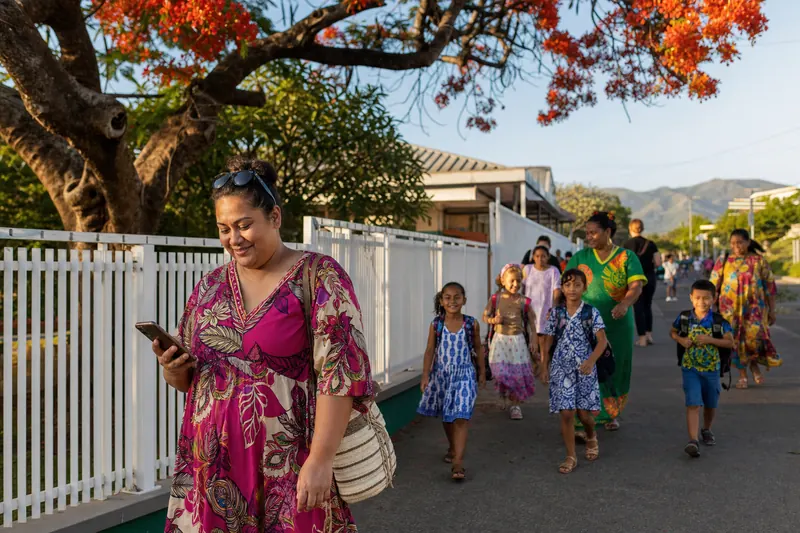
You write once, from a computer, and each contact receives their own version. The message goes out under your organisation's name, the send can be scheduled, and you know who received it. It's the usual route for a school telling the parents of a class, a clinic reminding patients of appointments, or a council informing residents, from Nouméa to the bush and the Islands.
From your own software
Business, booking or ordering software can send its own texts by calling an SMS API. That's the right route when a text should follow an event: an order shipped, an appointment booked.
In SMS PRO: all three are covered: single texts, group sends and the API. Sending SMS online
What is a sender ID, and how do you get one?
The sender ID is the word shown instead of a number at the top of the text, for example SCHOOL EX. It's also called an alphanumeric sender.
In New Caledonia, the name is registered with the local operator before it can be used. On its platform, it has 10 characters at most, spaces included.
Two practical consequences. Nobody can reply to a name: if you're expecting a call or an answer, put a number or a link in the message. And the name must be yours: your brand or trading name, never one that could pass for a public service or the operator.
Choose a name your recipients recognise at a glance, and stick with it. A name that changes from one send to the next blurs the signals, and those are exactly the signals your customers rely on to tell your texts apart from a scam.
In SMS PRO: we register your name for you, then check it with a real send. Your sender ID
How many characters are there in an SMS?
One SMS holds 160 characters. Beyond that, the message is split into parts of 153 characters each, which the phone stitches back together: a 200-character message counts as 2 SMS.
Those figures apply to the standard SMS alphabet. It covers unaccented letters, digits, common punctuation and a few accented letters, including é, è, à and ù. Good news for local place names: Nouméa costs nothing extra.
Other characters aren't in it: ê, â, î, ô, û, ç, capital letters with accents such as À, and the curly apostrophes and quotation marks that phones and word processors insert on their own. One of them is enough to switch the whole message to another alphabet, where an SMS holds only 70 characters, and each part 67. A 120-character message then goes from 1 SMS to 2.
| Message alphabet | 1 SMS | Each extra part |
|---|---|---|
| Standard SMS alphabet | 160 characters | 153 characters |
| Other alphabet (a single ê, ç or ’ is enough) | 70 characters | 67 characters |
A few signs, such as €, [ or ], stay in the standard alphabet but count as two. Emojis don't belong in a business text.
Try this draft, typed the way people type on a phone, with curly apostrophes: the counter flags the characters that make the message longer.
122 characters at the longest · 1 SMS · 38 left before SMS no. 2
In SMS PRO: characters outside the alphabet are simplified automatically, and the counter counts the message exactly as it will go out. Texting a whole list
How do you personalise a text without getting it wrong?
Write a single message with fields, such as {prenom} for the first name or {date}, which the tool fills in for each recipient. Then check the filled-in message for the contact with the longest details.
The trap is length. A 150-character message with "Jane" can go over 160 with "Alexandra-Marie". So count the filled-in message for the longest contact, not the template.
Before sending, check the preview on at least two real contacts: a short first name and a long one. Look out for empty columns too: a field with no value leaves a hole in the sentence.
One last point: the same parent can sit in two groups, for two children. If they should get two different messages, the tool has to tell them apart; if the text is identical, one is enough.
In SMS PRO: the counter and the number of SMS are worked out on each contact's actual message, the preview shows a real recipient, and a number found in two groups gets a single text if the wording is identical. Bulk SMS, step by step
How do you know a text has arrived?
From the delivery receipt the network sends back once it has handed the SMS to the phone. Without that receipt, you only know the message left, not that it arrived.
A message can stay without a receipt for several reasons: a phone switched off for a long time, out of coverage, or a network response that never comes. Saying so honestly beats a false "delivered": you know who to call.
An SMS doesn't send read receipts. What you can measure is delivery, and, when the message contains a link, clicks.
In SMS PRO: every text sent to a New Caledonian mobile gets a status: delivered, not delivered, or not confirmed when no receipt has come back after 24 hours. Understanding SMS statuses
Opt-out and consent: what do you need to do?
Give everyone a simple way to stop receiving your marketing texts, honour that request across all your sends, and get an individual's consent before sending them a promotion.
In New Caledonia, the French Data Protection Act (loi Informatique et Libertés) applies, and the GDPR has taken effect there through that Act since 1 June 2019. The CNIL, the French data protection authority, oversees it.1 2
Every recipient can object to marketing messages at any time, and that request must be honoured for all your sends.3 New Caledonia's Post and Telecommunications Code also protects everyone's right to forbid the use of their details for marketing.4
For a marketing text sent to an individual, getting their consent first is the safest practice: an unticked box, a sign-up they chose to make. A service message, such as an appointment reminder, isn't marketing as long as it contains no promotion.
A marketing text must clearly identify the organisation sending it and offer a simple way to stop receiving them.
What the rules say, text by text
In SMS PRO: an opt-out link confirmed by code, valid across your whole organisation, and voluntary sign-up by QR code. STOP opt-outs
What time should you text people in New Caledonia?
Your recipients' time. Nouméa runs on UTC+11, all year round, with no daylight saving.
If you schedule from elsewhere, the gap depends on the season where you are, because Australia, New Zealand and Europe all change their clocks while Nouméa doesn't.
| Send scheduled for 9 am in | Lands in Nouméa in January | Lands in Nouméa in July |
|---|---|---|
| Sydney | 9 am | 10 am |
| Auckland | 7 am | 8 am |
| Papeete | 6 am, the next day | 6 am, the next day |
| London | 8 pm | 7 pm |
| Paris | 7 pm | 6 pm |
Work out the arrival time with the Nouméa clock
We have found no New Caledonian text that sets hours for sending. Good practice is simple: no marketing at night, and reminders sent when people will read them, for example in the late afternoon the day before.
In SMS PRO: the send time is Nouméa time, a campaign can be spread over a time window, and a send scheduled at night can be flagged to the administrator. Scheduled SMS
How do you text New Caledonia from overseas?
Dial the international code, then the 6 digits: +687 56 00 01. On a mobile, the + replaces the international access code of the country you're in.
An organisation based outside New Caledonia that writes regularly to people here, such as an Australian or New Zealand company with customers in Nouméa, a training body or a government agency, is better off using a platform that sends locally: the sender ID is registered here, and texts to New Caledonian mobiles go out directly through the local operator.
And remember the time difference from the previous section: it's a classic mistake in sends prepared from overseas.
In SMS PRO: texts to New Caledonian mobiles go out directly through the local operator; texts to other countries use international routing. The SMS PRO platform
How do you stay recognisable as scam texts multiply?
By always looking the same. The same sender ID, your organisation's name at the start of the message, and links on a domain your recipients recognise.
And by never asking by text for what a scammer would ask for: a code, a password, bank details. Tell your customers so: they'll know a message like that isn't from you.
Spotting a scam text, and helping your customers do the same
The pre-send checklist
Eight checks, in the order they come up. Print it or copy it for your team.
- Numbers are in New Caledonian format, with no duplicates and no landlines.
- Your sender ID is registered, and it is yours.
- The message fits in one SMS for the contact with the longest details.
- It starts with the name of your organisation, or names it clearly.
- It gives a number or a link if you're expecting an answer.
- If it's marketing, it offers a way to stop receiving it, and you have a basis for sending it.
- The send time is Nouméa time, and it isn't the middle of the night.
- Someone else has proofread it.
Sources
- CNIL, "Loi Informatique et Libertés et RGPD : ce qui change pour l'outre-mer" (in French), 4 July 2019.
- Légifrance, French Act no. 78-17 of 6 January 1978 on information technology, data files and civil liberties, article 126 (in French).
- CNIL, "La prospection commerciale par courrier électronique, SMS-MMS et automate d'appel" (in French), updated 10 June 2026.
- Juridoc, Post and Telecommunications Code of New Caledonia, article 223-4 (in French; version consulted: updated 21 January 2015).
Cite this guide
Journalists, teachers, organisations: you are welcome to reuse this guide, as long as you cite it like this.
SMS PRO (Pacific Consulting), Sending SMS in New Caledonia: the guide, updated on 11 November 2026, https://www.smspro.nc/en/sending-sms-in-new-caledonia/
Update history
- : first published.